Enter your team or player names below, one per line, in seed order (strongest seed first). The generator builds a seeded single-elimination bracket for 4, 8, 16 or 32 slots and fills any empty slots with byes, exactly like a real tournament draw.
Click the winner of each match to advance them. Changing an earlier winner automatically clears any later picks that no longer fit, so the bracket always stays consistent.
What Is a Tournament Bracket Generator?
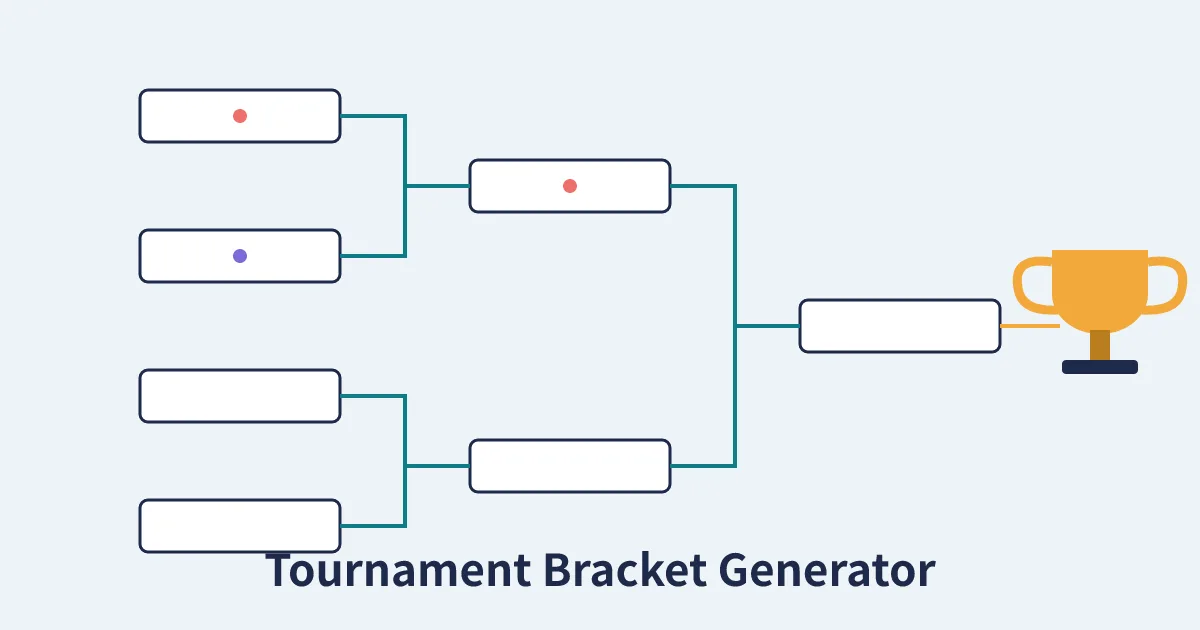
A tournament bracket generator turns a plain list of teams or players into a structured knockout draw. Instead of sketching boxes and lines on paper, you paste your names once and the tool arranges them into rounds, applies standard seeding, and tracks winners until a champion is decided. A game brackets generator like this one is built for the most popular format in sport and gaming: single elimination, where one loss sends a team home and every match matters.
The bracket above supports fields of 4, 8, 16 and 32. If your entry list falls between those sizes, the bracket automatically expands to the next size and pads the empty slots with byes, which is exactly how real tournament directors handle uneven fields. The top seeds receive the byes first, rewarding the strongest entrants with a free pass through the opening round.
How to Use the Bracket Generator
- List your teams. Type or paste one team or player name per line in the box. The order matters: the first name is seed 1, the second is seed 2, and so on.
- Shuffle if you want a random draw. The Shuffle Seeds button randomises the list order, which is ideal for casual events where nobody is formally ranked.
- Click Build Bracket. The generator creates the draw in seeded columns, from the first round through to the final, and auto-advances any team that drew a bye.
- Click winners as matches finish. Tap or click the winning team in each match and they move into the next round instantly.
- Crown the champion. When the final is decided, the winner is announced in the champion banner at the top of the bracket.
How Seeding Works in a Single-Elimination Bracket
Seeding is the system that keeps the strongest teams apart until the later rounds. In a standard seeded draw, seed 1 plays the lowest seed in round one, seed 2 plays the second-lowest, and the pairings are arranged so that seeds 1 and 2 can only meet in the final, seeds 1 to 4 can only meet in the semifinals, and so on. This generator uses the classic recursive seeding order used by professional tournaments, so an 8-team draw pairs 1 against 8, 4 against 5, 2 against 7 and 3 against 6.
Good seeding protects the quality of the whole event. Without it, the two best teams might collide in the first round and one of them is gone before the tournament has really started. With it, every round gets stronger as the field narrows, which is fairer for players and far more exciting for spectators.
What is a bye?
A bye is a free pass through a round. Brackets only work perfectly when the number of teams is a power of two, so when you enter, say, 11 teams, the draw expands to 16 slots and 5 slots are empty. Those empty slots become byes, and they are awarded to the highest seeds. If a match pairs a real team against a bye, the team advances automatically, which this tool handles for you the moment the bracket is built.
Worked Example: Running an 8-Team Bracket
Suppose a school runs a table-tennis cup with eight players listed strongest first: Falcons, Wolves, Sharks, Tigers, Eagles, Bears, Lions and Cobras. The first round pairs Falcons with Cobras (1 v 8), Tigers with Eagles (4 v 5), Wolves with Lions (2 v 7) and Sharks with Bears (3 v 6). If Falcons, Tigers, Wolves and Sharks win, the semifinals are Falcons against Tigers and Wolves against Sharks, and the winners of those matches meet in the final. A field of 8 needs exactly 7 matches to produce a champion, because every match eliminates precisely one team.
When to Use Single Elimination
Single elimination is the fastest and most dramatic format, so it suits one-day events, school competitions, office tournaments, esports nights and playoff rounds. It needs only N minus 1 matches for N teams, which makes scheduling simple. The trade-off is that one bad game ends a team’s day, so for long leagues where fairness over many matches matters more, a round robin is usually the better choice. For events with a fixed venue and a crowd waiting for a final, single elimination is hard to beat.
Brackets are also a natural partner for event planning: once the draw exists, a seating plan for spectators or a schedule of who plays on which day becomes much easier to organise. If you are arranging the room as well as the draw, our Seating Chart Generator can lay out the space, and the Random Date Generator can help pick fixture dates fairly.
Tips for a Smooth Tournament
- Confirm the final list before building. Adding or removing a team after the draw changes every pairing, so close entries first.
- Publish the seeding rule in advance. Tell players whether seeds come from rankings, last season’s results or a random shuffle, so nobody disputes the draw.
- Explain the byes. Players who receive a bye have not skipped a match unfairly; it is the standard reward for a top seed.
- Record results immediately. Click each winner as soon as a match ends so the bracket everyone sees is always current.
- Plan the final. Keep the best court, table or screen for the final and announce the champion as soon as the last match ends.
Bracket Formats Compared: Is Single Elimination Right for You?
Single elimination is one of three formats organisers reach for, and choosing well matters more than any other decision you will make. In single elimination, used by this generator, one loss eliminates a team. It needs the fewest matches (N − 1), produces a champion quickly, and makes every game a final, which is why cup competitions, playoffs and game-night tournaments use it. Its weakness is mercy: a strong team that has one bad evening goes home, and half your field plays only a single match.
Double elimination gives every team a second life. Losers drop into a lower bracket and are only eliminated after a second defeat, so the champion must be beaten twice, or beat the lower-bracket winner in a final. It is the standard for esports majors and serious fighting-game events because it forgives one bad match, at the cost of roughly twice as many games and a far more complex draw that needs specialist software.
Round robin guarantees everyone plays everyone: N(N − 1)/2 matches, no eliminations, and the fairest possible ranking by the end. Leagues love it because every team gets a full schedule, but it is slow and late matches can become meaningless once the top is settled. Many real competitions combine formats: round-robin groups feeding a single-elimination playoff, which is the structure of most football World Cups.
For a one-day event, a school cup, an office championship or a party tournament, single elimination wins on simplicity and drama. If your event is fictional, a story tournament, a school quidditch league or a guild championship in a role-playing campaign, the format adds narrative tension for free, and you can invent suitably heroic team names with a little help from our Random Character Generator for the players themselves.
Frequently Asked Questions
How many teams can the bracket generator handle?
It supports up to 32 teams or players. The bracket expands to the nearest bracket size of 4, 8, 16 or 32 slots and fills any spare slots with byes, so any field from 2 to 32 teams works.
What happens if I enter a number of teams that is not a power of two?
The bracket grows to the next full size and the missing slots become byes. The byes go to the top seeds first, and any team drawn against a bye advances to the next round automatically.
How does seeding work in this generator?
The first name on your list is seed 1, the second is seed 2, and so on. The generator uses the standard tournament seeding order, so the strongest seeds are kept apart until the latest possible round: seed 1 meets seed 2 only in the final.
Can I change a winner after clicking the wrong team?
Yes. Click the other team in that match instead. The bracket recalculates from that point and clears any later winners that no longer fit, so the draw never shows an impossible result.
What does the Shuffle Seeds button do?
It randomises the order of your list, which turns the draw into a lottery. That is perfect for friendly events where players are not ranked and everyone wants the pairings to be decided by luck.
How many matches does a single-elimination tournament need?
Exactly one fewer than the number of teams. An 8-team event needs 7 matches, a 16-team event needs 15, and a 32-team event needs 31, because every match eliminates exactly one team.
Is this bracket generator free to use?
Yes. It is completely free, needs no account, and everything runs in your browser, so your team lists are never uploaded anywhere.