Convert moles to grams, or grams back to moles, for a real substance. Pick one of twenty elements and compounds, or enter your own molar mass, and the answer updates as you type. The line under the result shows the exact formula with your numbers substituted in, so you can copy the working into your homework or lab notes.
Molar masses use standard atomic weights (IUPAC 2021) rounded to three decimal places, the values most periodic tables print. Your teacher’s table may round slightly differently, which can move the last decimal of an answer.
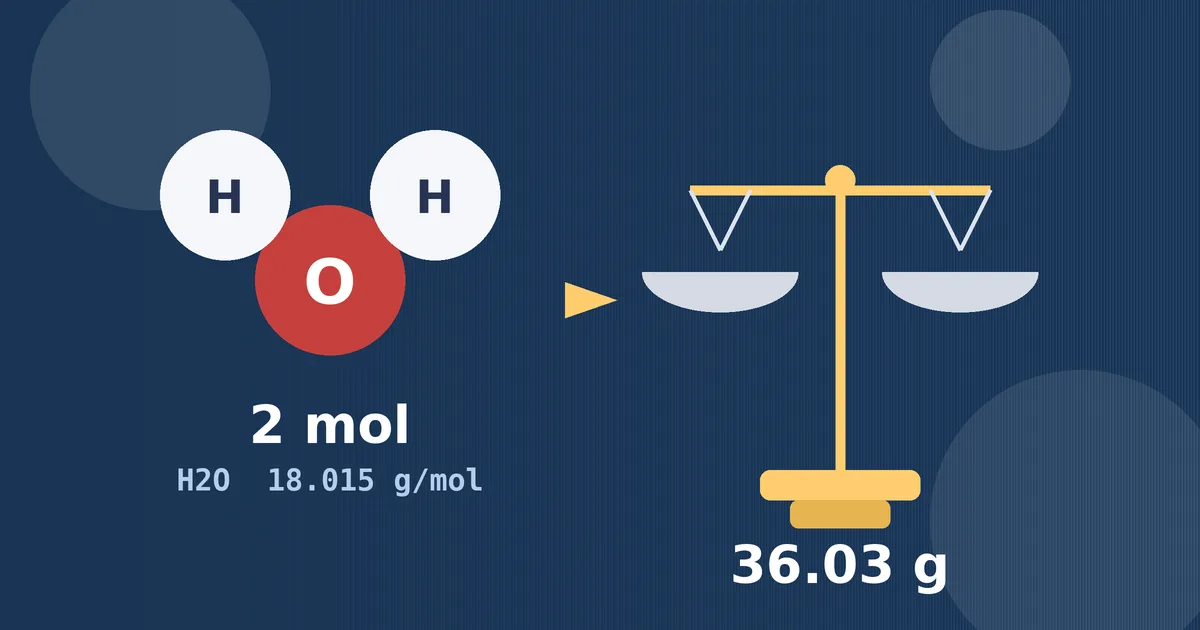
How to Use This Moles to Grams Converter
- Choose a direction. Moles to grams turns an amount of substance into a mass you can weigh. Grams to moles does the reverse, starting from a weighed mass. The unit next to the amount box changes to match.
- Enter the amount. Type how many moles, or how many grams, you have. The result updates live as you type; there is no Convert button to press.
- Pick the substance. The list holds ten elements and ten common compounds, each with its molar mass in grams per mole. Molar mass is what turns a count of particles into a weight, so this choice matters most.
- Use Custom molar mass when your substance is not listed. Choosing it reveals a molar mass box. Work out the value from the periodic table using the method below, type it in, and the converter uses it for both directions.
- Read the result and the working. The large line gives the answer. The smaller line underneath shows the substituted formula, such as mass = 2 mol × 18.015 g/mol = 36.03 g, so you can see exactly where the number came from.
What Is a Mole?
A mole is chemistry's counting unit. Atoms and molecules are far too small and far too numerous to count one by one, so chemists count them in a very large group instead, in the same way that eggs are counted in dozens. One mole of anything contains 6.022 × 10²³ particles. That number is called Avogadro's number, and the particles can be atoms, molecules or ions, depending on the substance.
To feel how big that is: one mole of water molecules is 6.022 × 10²³ molecules, yet it weighs only about 18 grams and would fill roughly a tablespoon and a half. The mole bridges two worlds. Reactions are written in moles, because particles join in simple whole-number ratios, but in the laboratory things are weighed on a balance in grams. Converting between moles and grams moves from the equation on the page to the powder or liquid on the bench.
The link between the two worlds is molar mass: the mass, in grams, of one mole of a substance. Every substance has its own molar mass, because its particles have their own masses. One mole of hydrogen weighs almost nothing, one mole of gold weighs nearly 200 grams, and both contain exactly the same number of atoms.
The Formulas for Converting Moles and Grams
Both directions come from a single relationship, and each is just the other one rearranged:
Mass (g) = moles × molar mass (g/mol)
Moles = mass (g) ÷ molar mass (g/mol)
To go from moles to grams you multiply, because each mole adds one molar mass worth of grams. Two moles of a substance weigh twice as much as one mole, ten moles weigh ten times as much, and the multiplication does exactly that. To go from grams to moles you divide, because you are asking how many complete molar-mass portions fit inside your weighed sample.
The units check the direction for you. In the first formula, mol × g/mol cancels the moles and leaves grams. In the second, g ÷ g/mol cancels the grams and leaves moles. If your working leaves you with the wrong unit, the operation is the wrong way round, and that simple check catches one of the most common homework errors before it costs marks.
How to Find Molar Mass from the Periodic Table
For an element, molar mass is the easiest number in chemistry: read the atomic mass off the periodic table and change its unit to g/mol. Carbon is 12.011, so one mole of carbon atoms weighs 12.011 grams. For a compound, you build the molar mass yourself, element by element: multiply each element's atomic mass by how many atoms of it appear in the formula, then add the pieces together. The small subscript number after each symbol is the count, and an element with no subscript appears once.
Worked build: glucose, C₆H₁₂O₆. Glucose contains three elements, so there are three lines of working. Carbon: the subscript is 6, and carbon's atomic mass is 12.011, so 6 × 12.011 = 72.066. Hydrogen: the subscript is 12, and hydrogen's atomic mass is 1.008, so 12 × 1.008 = 12.096. Oxygen: the subscript is 6, and oxygen's atomic mass is 15.999, so 6 × 15.999 = 95.994. Adding the three contributions gives 72.066 + 12.096 + 95.994 = 180.156 g/mol, which is the value in the converter's list.
The same routine builds every preset in this tool. Water, H₂O, is 2 × 1.008 for the hydrogen plus 15.999 for the oxygen, giving 18.015 g/mol. Carbon dioxide, CO₂, is 12.011 + 2 × 15.999 = 44.009 g/mol. Once you can build two or three of these confidently, no molar mass in a school course should slow you down.
Worked Examples in Both Directions
2 moles of water, in grams. Water's molar mass is 18.015 g/mol, so mass = 2 × 18.015 = 36.03 g.
100 grams of sodium chloride, in moles. Sodium chloride has a molar mass of 58.443 g/mol, so moles = 100 ÷ 58.443 = 1.711 mol.
0.5 moles of carbon dioxide, in grams. Carbon dioxide has a molar mass of 44.009 g/mol, so mass = 0.5 × 44.009 = 22.0045 g, which rounds sensibly to 22.00 g.
A custom example. Suppose your substance is not listed and you worked out a molar mass of 10 g/mol. Choosing Custom molar mass and entering 10, five moles gives 5 × 10 = 50 g. The custom option follows the same formula; only the source of the molar mass changes.
Common Molar Masses Table
These are exactly the molar masses the converter uses: standard atomic weights (IUPAC 2021) rounded to three decimal places, with compound values built by adding their elements.
| Substance | Formula | Molar mass (g/mol) |
|---|---|---|
| Hydrogen | H | 1.008 |
| Carbon | C | 12.011 |
| Nitrogen | N | 14.007 |
| Oxygen | O | 15.999 |
| Sodium | Na | 22.990 |
| Chlorine | Cl | 35.45 |
| Calcium | Ca | 40.078 |
| Iron | Fe | 55.845 |
| Copper | Cu | 63.546 |
| Gold | Au | 196.967 |
| Water | H₂O | 18.015 |
| Carbon dioxide | CO₂ | 44.009 |
| Sodium chloride | NaCl | 58.443 |
| Glucose | C₆H₁₂O₆ | 180.156 |
| Sulfuric acid | H₂SO₄ | 98.079 |
| Calcium carbonate | CaCO₃ | 100.086 |
| Methane | CH₄ | 16.043 |
| Ammonia | NH₃ | 17.031 |
| Ethanol | C₂H₆O | 46.068 |
| Sucrose | C₁₂H₂₂O₁₁ | 342.296 |
Common Mistakes to Avoid
- Using the atomic mass of one element for a whole compound. Oxygen alone is 15.999 g/mol, but carbon dioxide is 44.009 g/mol, because the carbon and both oxygen atoms all count.
- Ignoring subscripts. The 2 in H₂O doubles hydrogen's contribution, and the 12 in glucose multiplies hydrogen by twelve. A missed subscript is a frequent source of wrong molar masses.
- Multiplying when you should divide, or the reverse. Moles to grams multiplies by molar mass; grams to moles divides. Use the unit check: the unit you start with should cancel, leaving the unit you want.
- Mixing up units. The amount must be in moles and the mass in grams for these formulas. Kilograms must become grams first, and molar mass belongs in g/mol, not in kilograms or in atomic mass units left unconverted.
- Assuming one mole always weighs the same. A mole is a count, not a weight. One mole of methane weighs 16.043 g and one mole of sucrose weighs 342.296 g, more than twenty times as much, because their molecules are built from different numbers of atoms.
- Rounding too early. Keep the full molar mass, such as 58.443, through the calculation and round only the final answer. Rounding to 58 at the start moves the sodium chloride answer from 1.711 mol to 1.72 mol for no reason.
More Tools on This Site
Two nearby tools answer different questions. The Grams to Milliliters Converter converts mass to volume using density, which is a different bridge from molar mass: density connects grams to milliliters, while this page connects grams to the amount of substance. When a problem asks how concentrated a solution is, the Molarity Calculator works with moles per liter. For moving between grams, kilograms, ounces and pounds inside mass alone, use the Weight Converter.
Frequently Asked Questions
How do you convert moles into grams?
Multiply the number of moles by the molar mass of the substance in grams per mole. For example, 2 moles of water multiplied by its molar mass of 18.015 g/mol gives 36.03 grams. The moles cancel out and leave grams, which is a quick way to check that you multiplied the right way round.
How do you convert grams into moles?
Divide the mass in grams by the molar mass in grams per mole. For example, 100 grams of sodium chloride divided by 58.443 g/mol gives 1.711 moles. In the converter, choose Grams to moles, enter the mass and pick the substance, and it does the division for you.
How do I find the molar mass of a compound?
Add up the atomic masses of every atom in the formula, counting each element as many times as its subscript says. For glucose, that is 6 carbons at 12.011, 12 hydrogens at 1.008 and 6 oxygens at 15.999, which adds up to 180.156 g/mol. Elements with no subscript count once.
Is molar mass the same as atomic mass?
They are closely related but not identical in use. Atomic mass is the mass of one element as printed on the periodic table, such as 12.011 for carbon. Molar mass is the mass of one mole of a whole substance: for an element it matches the atomic mass in g/mol, but for a compound you must add up every atom in the formula first.
Why does one mole of different substances weigh different amounts?
Because a mole counts particles, and particles of different substances have different masses. One mole is always 6.022 × 10²³ particles, but a mole of hydrogen atoms is light at 1.008 grams while a mole of gold atoms is heavy at 196.967 grams, because each gold atom contains far more protons and neutrons.
Can I convert a substance that is not in the list?
Yes. Choose Custom molar mass in the substance list and type the molar mass in g/mol from your periodic table or textbook. The converter then uses your value for both directions. It must be greater than zero, and it is worth double-checking the value, because every later step depends on it.