From Garden Beds to Dry Creek Beds: One Simple Answer
River rock turns an ordinary yard into a finished landscape — a dry creek bed that channels storm water, a ring of cobbles around a tree, a low-maintenance bed that never needs mulching again. The only hard part is ordering the right amount. Too little and you stall the project halfway; too much and you pay for a heavy load that sits in your driveway for a year.
This free river rock calculator does the estimating for you. Measure your bed, pick your rock size, and get cubic yards, cubic feet, tons, and the number of bags — with a waste allowance built in. It even warns you if your chosen depth is too shallow for the rock size you picked, which is the mistake that ruins more rock beds than any other.
River rock weighs about 1.5 tons per cubic yard. Your supplier’s actual density may vary slightly — confirm before ordering a large load.

How to Use the River Rock Calculator
- Choose your bed shape. Rectangle for beds and dry creek beds, Circle for tree rings and round planters.
- Enter the dimensions in feet. For a rectangle, length × width; for a circle, the diameter straight across.
- Set the depth in inches. 3–4 inches is the sweet spot for most projects — the guide below explains why depth depends on rock size.
- Pick your rock size. This adjusts the minimum-depth warning: larger rock needs a deeper bed to cover the ground completely.
- Leave the waste allowance at 10%. It covers uneven ground, settling, and edging cuts. Raise it for bumpy or irregular sites.
- Click Calculate River Rock. The headline answer is cubic yards (how bulk yards sell it), plus tons, bags, and a full step-by-step breakdown.
What Is River Rock? (And How It Differs From Pea Gravel)
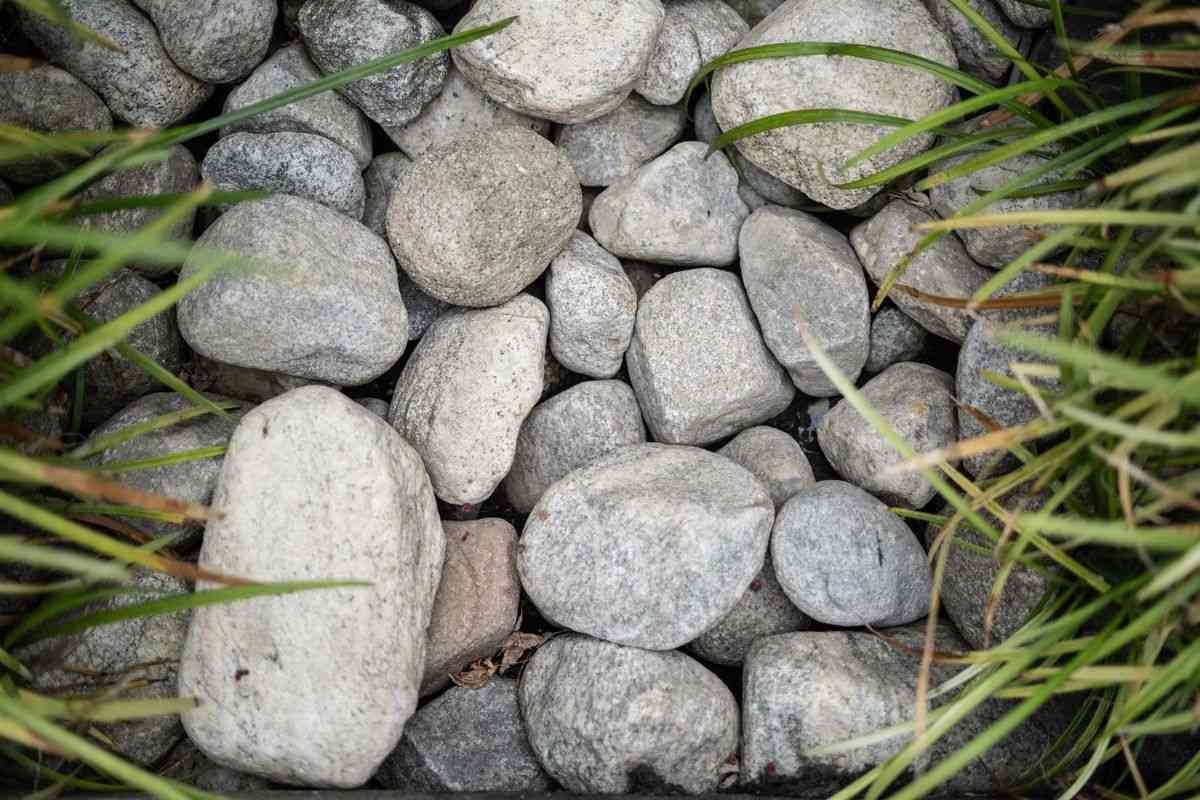
River rock is natural stone that has been tumbled smooth by water — river beds and old glacial deposits are the classic sources. Because each stone is rounded instead of crushed, pieces nest loosely and leave generous air gaps between them. That loose structure is exactly what makes river rock the go-to choice for drainage and decorative beds: water flows straight through instead of pooling, and the stones stay cool and natural-looking for decades.
Pea gravel, its close cousin, is much smaller (about 1/4 to 1/2 inch) and better suited to paths and patios where foot comfort matters. The practical differences:
- Size: river rock typically runs 1 inch up to 8 inches and beyond; pea gravel is tiny by comparison.
- Drainage: bigger stones mean bigger gaps — river rock drains faster and clogs less, which is why it lines dry creek beds and French drains.
- Stability: heavy river rock stays where you put it; light pea gravel migrates and scatters underfoot.
- Foot traffic: don't walk on large river rock — it's ankle-twisting. Pea gravel paths are comfortable; river rock beds are look-don't-walk.
- Longevity: both outlast mulch by decades, since stone never decomposes.
If you're covering a walkway or patio seating area, our pea gravel calculator is the right tool. If you're building drainage, edging, or decorative beds, you're in the right place.
The Formula: How Much River Rock Do You Need?
Cubic yards = Cubic feet ÷ 27
Tons = Cubic yards × 1.5
Depth must be in feet before it goes into the formula, so divide inches by 12 first (4 inches = 0.333 ft). Bulk yards sell river rock by the cubic yard, so that final division by 27 is the step that matters most.
Worked example: a dry creek bed. Say you're building a dry creek bed 20 feet long and 4 feet wide, with rock 4 inches deep:
- Area: 20 × 4 = 80 sq ft
- Depth in feet: 4 ÷ 12 = 0.333 ft
- Cubic feet: 80 × 0.333 = 26.67 cu ft
- Cubic yards: 26.67 ÷ 27 = 0.99 yd³ — order 1 cubic yard
- Tons: 0.99 × 1.5 = 1.48 tons (about 2,970 lb)
- Bags: 26.67 ÷ 0.5 = 54 bags of standard 0.5 cu ft bags
Circular example: a tree ring. An 8-foot-diameter ring at 3 inches deep: area = π × 4² = 50.27 sq ft; depth = 0.25 ft; volume = 12.57 cu ft ÷ 27 = 0.47 cubic yards — roughly 0.70 tons, or 26 bags.
Add 10% waste on real projects (the calculator does this for you), and always round bulk orders up — a half-empty bed looks worse than a small leftover pile.
Choosing the Right River Rock Size
Rock size isn't just cosmetic — it decides your minimum bed depth. Small stones pack tightly and cover soil with a thin layer; big cobbles leave tall gaps that show bare ground if the bed is too shallow. The rule of thumb: the bed should be at least as deep as the largest stone is tall, and deeper is safer.
| Rock size | Best uses | Minimum depth |
|---|---|---|
| 1–2 in (river pebbles) | Garden beds, borders, around plantings | 2–3 in |
| 2–4 in (cobbles) | Dry creek beds, downspout splash areas, edging | 3–4 in |
| 4–8 in (large cobbles) | Dry creek bed base layer, erosion control, accents | 4–6+ in |
Mixing sizes is a pro move: a base of 2–4 inch cobbles with 1–2 inch pebbles filling the gaps gives a dry creek bed a natural riverbed look and locks everything in place. Buy about 70% large and 30% small for that effect.
Tips for Buying and Laying River Rock
- Lay woven landscape fabric first, not plastic. Fabric blocks weeds while letting water through — plastic sheeting traps water and defeats the whole drainage purpose.
- Confirm the density with your supplier. 1.5 tons per cubic yard is the standard estimate, but wet or unusually dense stone can weigh more, and most suppliers publish their own figure.
- Order bulk for anything over half a yard. Bagged rock costs 2–3× more per cubic foot. One cubic yard equals roughly 54 standard 0.5 cu ft bags.
- Ask about delivery placement. A full ton of rock is heavy to move twice — have the truck dump as close to the bed as possible, on a tarp if your driveway is new.
- Edge the bed. Steel or stone edging keeps rock from migrating into the lawn and makes the finished edge look sharp. Add 2 inches of depth near edges, which get kicked around most.
- Rinse dusty loads. Freshly delivered rock is often coated in quarry dust. A quick hose-down after spreading reveals the true color — most river rock darkens and looks richer when wet.
- Keep rock away from the house foundation. A 6-inch gap between rock beds and siding prevents moisture wicking and gives termite inspectors clear access.
Quick Coverage Table: How Far One Load Goes
Once you know your volume, this is the table people actually come back for: how much ground one cubic yard — or one ton — of river rock covers at common depths. The math is straightforward: one cubic yard is 27 cubic feet, so it covers 108 square feet at 3 inches deep (27 ÷ 0.25). At the standard density of 1.5 tons per cubic yard, one ton is 18 cubic feet of rock.
| Depth | 1 cubic yard covers | 1 ton covers (at 1.5 t/yd³) |
|---|---|---|
| 2 inches | ~162 sq ft | ~108 sq ft |
| 3 inches | ~108 sq ft | ~72 sq ft |
| 4 inches | ~81 sq ft | ~54 sq ft |
| 6 inches | ~54 sq ft | ~36 sq ft |
Two real-world caveats. First, large cobbles leave bigger air gaps, so beds of 4-inch-plus rock need 10–15% more volume than the table suggests — the calculator's waste allowance covers this. Second, always confirm your supplier's density: wet stone or dense varieties can weigh more than 1.5 tons per yard, and suppliers usually publish their own figure on the product page.
More Construction Tools
Frequently Asked Questions
How much river rock do I need per square foot?
At 3 inches deep, one square foot needs 0.25 cubic feet of rock — so 100 square feet needs 25 cubic feet, or about 0.93 cubic yards. The calculator above works this out for any depth and adds a waste allowance.
How many tons are in a cubic yard of river rock?
About 1.5 tons (3,000 pounds) per cubic yard. That figure varies a little by stone type and moisture — suppliers publish their own density, so confirm before ordering a large load.
What is the difference between river rock and pea gravel?
River rock is larger (1–8 inches), heavier, and better for drainage and decorative beds; it stays put and water flows through it. Pea gravel is tiny (1/4–1/2 inch), comfortable underfoot, and better for paths and patios — but it migrates and needs edging.
How deep should river rock be?
At least 2–3 inches for 1–2 inch pebbles, 3–4 inches for 2–4 inch cobbles, and 4–6 inches or more for large cobbles. The bed should always be at least as deep as your largest stone is tall, or bare fabric will show through.
What size river rock is best for a dry creek bed?
2–4 inch cobbles for the main bed, with a few 4–8 inch accent stones along the edges. A 70/30 mix of larger cobbles to 1–2 inch pebbles gives the most natural riverbed look and locks the bed in place.
Do I need weed barrier fabric under river rock?
Yes — use woven landscape fabric, not plastic sheeting. Fabric blocks weeds while letting water drain through; plastic traps water, which defeats the drainage purpose of the rock.
How many bags of river rock make a cubic yard?
One cubic yard equals 27 cubic feet, and standard landscape bags hold 0.5 cubic feet — so about 54 bags. For anything over half a yard, bulk delivery is far cheaper than bags.
Does river rock help with drainage?
Yes — it's one of the best materials for it. The rounded stones leave large air gaps that let water flow through freely, which is why river rock lines dry creek beds, French drains, and downspout splash zones. It won't clog the way fine gravel can.
How much area does one ton of river rock cover?
At the standard estimate of 1.5 tons per cubic yard, one ton is about 18 cubic feet of rock. At 3 inches deep that covers roughly 72 square feet; at 2 inches about 108 square feet; at 4 inches about 54. Density varies by stone type and moisture, so confirm your supplier's figure before ordering a large load.
What does river rock cost per ton?
It varies a lot by region and rock size, but the material alone typically runs roughly $50–$150 per ton, with delivery and installation pushing the total toward $150–$250+ per ton. Bagged rock costs far more per cubic foot, so order bulk for anything over half a cubic yard.
Related Calculators