
How Much Fluid Moves Through Your Pipe?
Whether you are sizing an irrigation line, checking a sump pump, or speccing a hydronic loop, one number drives every decision: the volumetric flow rate — how much fluid passes a point per unit of time. This free calculator gives you that number two ways: from pipe diameter and flow velocity (the design method), or from a measured volume over time (the field method).
Results appear instantly in the four units tradespeople actually use: gallons per minute (GPM), liters per minute, cubic meters per hour, and cubic feet per second. No signup, no data stored — everything runs privately in your browser.
Pipe flow · Volume over time
Please enter values greater than zero for the active method.
Flow rate
Assumes steady, uniform flow through a full pipe. Real systems lose flow to friction, fittings, elevation and partial fill — treat this as a planning estimate, then verify with a flow meter for critical applications.
How to Use the Flow Rate Calculator
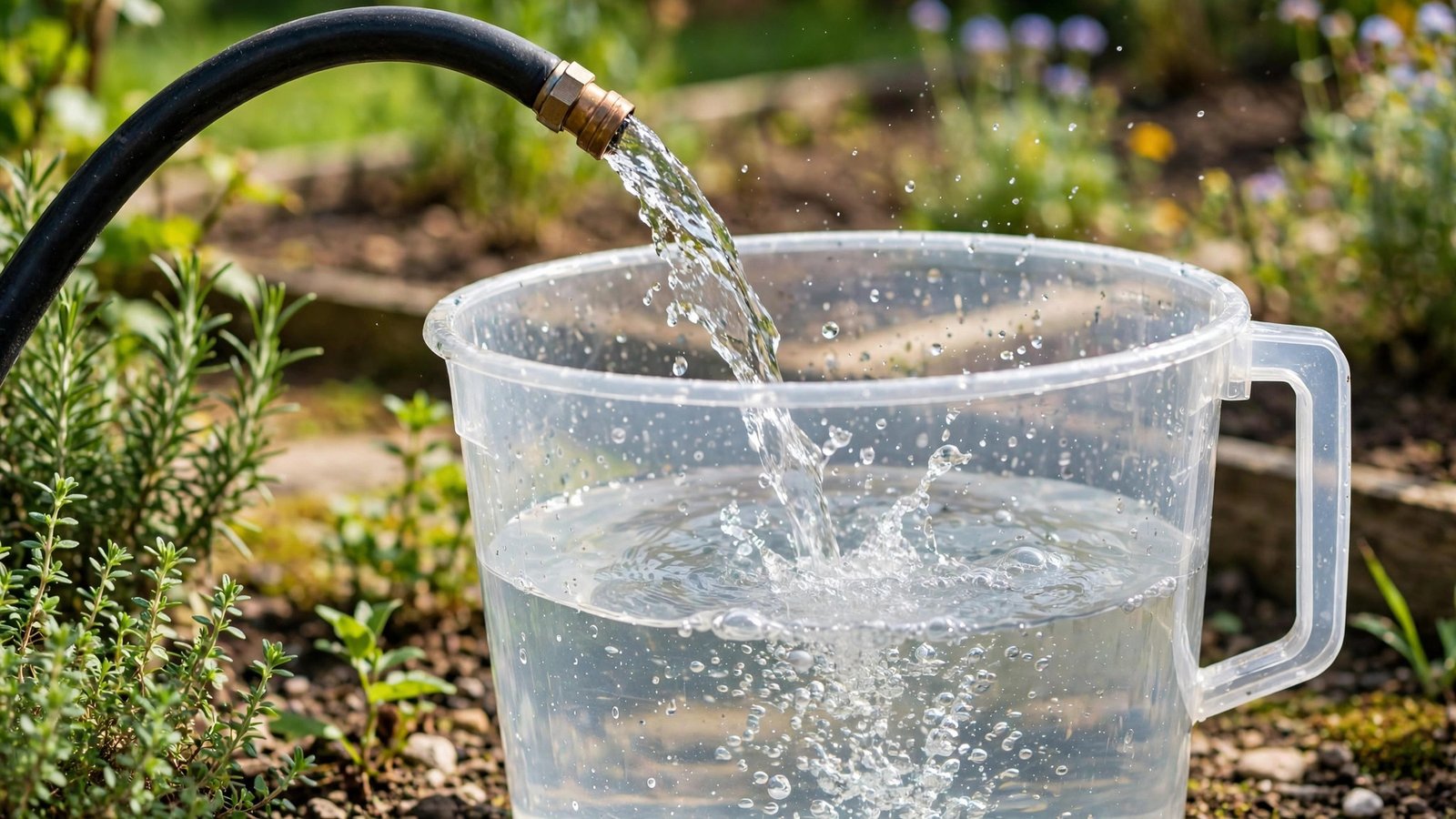
- Pick a method. Use Pipe: diameter × velocity when designing or checking a system on paper. Use Volume ÷ time when you can actually measure — e.g. timing how long it takes to fill a bucket.
- Enter your numbers. For the pipe method: inside diameter and average fluid velocity. For the volume method: the volume collected and the time it took.
- Read all four units. GPM is the headline for US plumbing and irrigation; L/min and m³/h suit metric specs; CFS appears in hydrology and civil work.
The Formulas
Volume method: Q = V ÷ t
Worked example (pipe): a 4-inch pipe with water moving at 5 ft/s. Area = π × (2 in)² = 12.57 in² = 0.0873 ft². Q = 0.0873 × 5 = 0.436 ft³/s = 195.8 GPM.
Worked example (volume): a 100-gallon tank fills in 5 minutes. Q = 100 ÷ 5 = 20 GPM (75.7 L/min).
Flow Rate Unit Conversions
| From | Multiply by | To get |
|---|---|---|
| GPM | 3.785 | L/min |
| GPM | 0.2271 | m³/h |
| GPM | 0.002228 | ft³/s (CFS) |
| L/min | 0.2642 | GPM |
| m³/h | 4.403 | GPM |
Who Uses Flow Rate Calculations
- Irrigation designers sizing zones so every sprinkler head gets its rated GPM.
- Plumbers & HVAC techs verifying pump and pipe selections against fixture demand.
- Pond & pool owners matching pumps to filters, waterfalls and turnover targets.
- Students checking fluid-mechanics homework on continuity (Q = Av).
Practical tips
- Measure the inside diameter, not the outside — pipe wall thickness eats a surprising amount of area.
- Typical residential water velocity is 3–5 ft/s; above ~8 ft/s you risk noise, wear and water hammer.
- For the bucket test, use at least a 5-gallon bucket and time with your phone — short timings magnify error.
The Plumber’s Shortcut: GPM ≈ 2.448 × d² × v
When the diameter is in inches and the velocity in feet per second, the whole Q = A × v chain collapses into one line:
The constant 2.448 bundles three things: the circle-area factor (π/4), the square-inch-to-square-foot conversion (÷144), and the cubic-feet-per-second-to-GPM conversion (×448.83). Test it against the worked example above: 2.448 × 4² × 5 = 2.448 × 80 = 195.84 GPM — the same answer the long way produced (195.8 GPM). It is the fastest sanity check in the trade: if a proposed pipe-and-pump combination cannot reach your target on this formula, no amount of optimism will fix it.
Frequently Asked Questions
What is flow rate?
Flow rate is the volume of fluid passing a point per unit of time — most commonly gallons per minute (GPM) in the US or liters per second internationally. It answers “how much, how fast.”
How do you calculate flow rate from pipe size?
Multiply the pipe’s cross-sectional area by the fluid velocity: Q = π × (d/2)² × v. Use the inside diameter in consistent units, then convert to GPM or L/min.
What is a good GPM for a house?
Most US homes are served at 6–12 GPM. A shower uses ~2.5 GPM, a dishwasher ~1.5 GPM, and irrigation zones often draw 8–15 GPM each.
How many GPM is 1 inch of water flow?
It depends on velocity, not just diameter. A 1-inch pipe at 5 ft/s carries about 12 GPM; at 8 ft/s it carries about 19 GPM. Diameter alone doesn’t set flow — velocity completes the equation.
What is the difference between GPM and PSI?
GPM measures how much water moves; PSI measures how hard it pushes. A tiny pinhole leak can show high PSI but almost zero GPM. You need both numbers to describe a system.
How accurate is the volume-over-time method?
Very — it measures reality rather than modeling it. Its only error sources are your volume marking and your stopwatch. For critical work, repeat three times and average.
What is the fastest way to estimate GPM from pipe size and velocity?
Use the shortcut GPM ≈ 2.448 × d² × v, with the inside diameter in inches and the velocity in feet per second. A 2-inch pipe at 5 ft/s, for example, carries about 2.448 × 4 × 5 ≈ 49 GPM. It gives the same answer as the full area-times-velocity method — it just pre-combines the constants.
Final Thoughts
Flow rate is one of those numbers that looks simple and quietly controls everything downstream — pump choice, pipe sizing, zone counts, even water bills. Run the numbers before you buy parts, and when in doubt, measure: a bucket and a stopwatch beat a guess every time.
Try our cubic yard calculator for bulk materials.