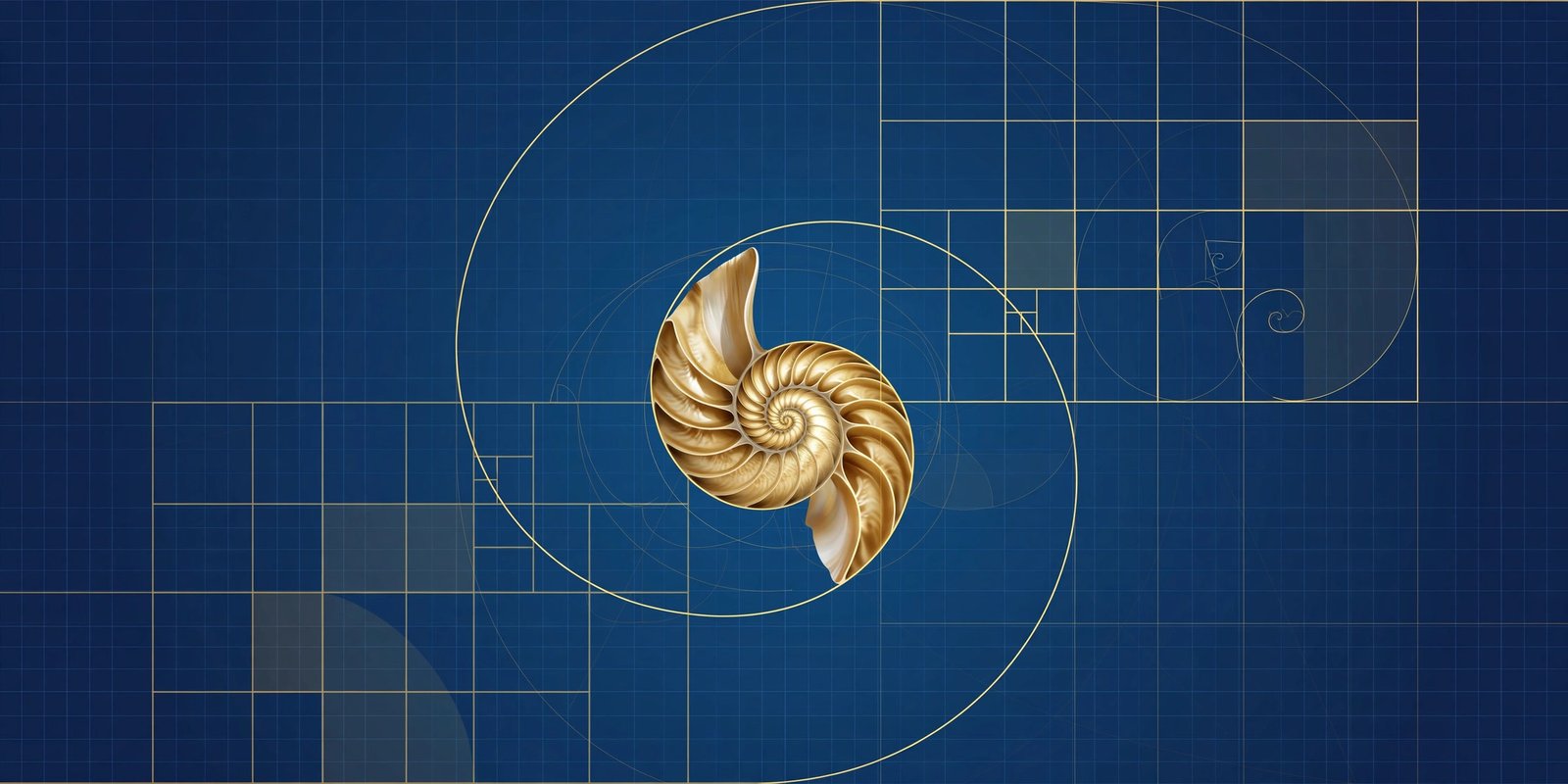
0, 1, 1, 2, 3, 5, 8, 13, 21… — the Fibonacci sequence is mathematics’ most famous pattern: every number is the sum of the two before it. First described by Leonardo of Pisa in 1202, it shows up in sunflower spirals, pinecones, stock-market retracements and algorithm design.
This free Fibonacci calculator finds any term F(n) up to n = 1000 exactly — no floating-point rounding — and optionally shows the full sequence, its sum, and how the ratio of consecutive terms converges to the golden ratio φ ≈ 1.6180339887.
F(n) = F(n−1) + F(n−2) · exact big integers
Please enter a whole number between 0 and 1000.
F(0) = 0, F(1) = 1. As n grows, the ratio F(n)/F(n−1) converges to the golden ratio φ ≈ 1.6180339887 — the same proportion found in sunflowers, nautilus shells and classical architecture.
How to Use This Calculator
- Enter the term number n (0 to 1000) whose Fibonacci number you want.
- Toggle the options — show the full sequence from F(0) to F(n), and the sum of all terms.
- Click Calculate for F(n), the digit count, F(n−1), the golden-ratio approximation and the sequence list.
Fibonacci definition
Closed form (Binet’s formula): F(n) = (φⁿ − ψⁿ) / √5, where φ = (1+√5)/2 and ψ = (1−5)/2
Worked example
Find F(10):
0, 1, 1, 2, 3, 5, 8, 13, 21, 34, 55 → F(10) = 55
Sum check: F(0)+…+F(10) = F(12) − 1 = 144 − 1 = 143
Golden ratio: 55/34 = 1.6176… (already close to φ = 1.6180339887)
Where Fibonacci numbers appear
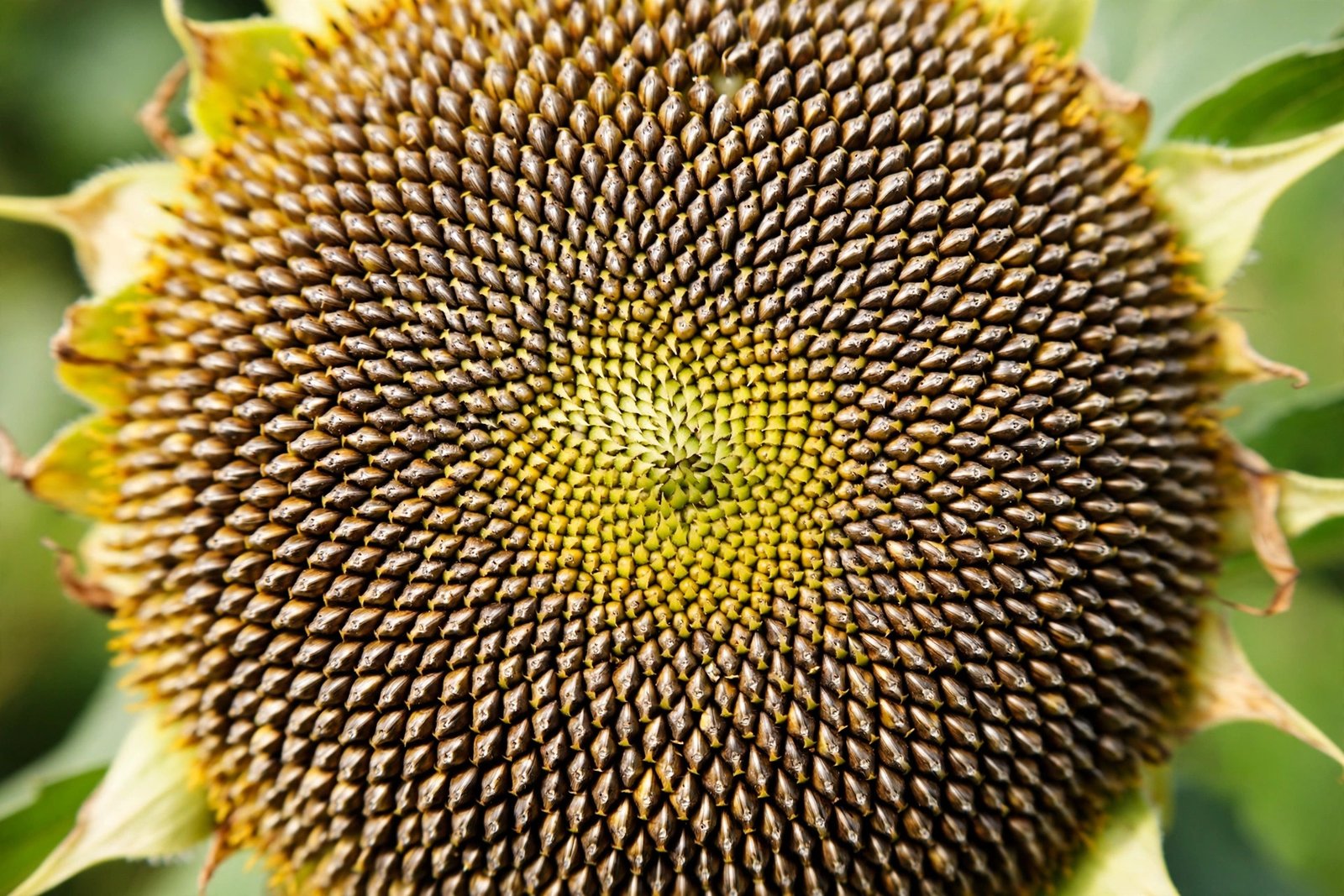
- Nature: petal counts, sunflower spirals and pinecone scales follow Fibonacci numbers — optimal packing solutions evolution discovered first.
- Trading: Fibonacci retracement levels (23.6%, 38.2%, 61.8%) are drawn from ratios of the sequence.
- Computer science: Fibonacci heaps, search algorithms and the classic recursion-vs-iteration teaching example.
- Art & design: the golden ratio φ, the limit of F(n)/F(n−1), underlies the “divine proportion” used since antiquity.
Identities: Patterns Hiding Inside the Sequence
The recurrence F(n) = F(n−1) + F(n−2) generates the sequence, but some of its prettiest facts are not obvious from the rule. Cassini’s identity says F(n−1)·F(n+1) − F(n)² = (−1)n — check n = 5: 3 × 8 − 25 = −1, exactly (−1)5. The sum of squares of the first terms collapses neatly: 0² + 1² + 1² + 2² + 3² + 5² = 40 = F(5)·F(6) = 5 × 8, and that holds for every n. And divisibility has a rhythm: every third term is even (0, 2, 8, 34, 144…), and F(m) always divides F(n) when m divides n — F(3) = 2 divides F(6) = 8 and F(9) = 34. Try verifying each one against the calculator’s output above.
How Fast Does F(n) Grow?
Because each term is about φ ≈ 1.618 times the previous one, the digits pile up fast: F(n) gains roughly 0.2090 digits per step. F(100) already has 21 digits — 354,224,848,179,261,915,075 — and F(1000), the limit this calculator handles, has 209 digits. That is why the tool uses exact integer arithmetic instead of floating point: a double-precision Binet calculation would start rounding long before n = 100, while the calculator above returns all 209 digits of F(1000) precisely.
Frequently Asked Questions
What are the first 10 Fibonacci numbers?
0, 1, 1, 2, 3, 5, 8, 13, 21, 34. Each is the sum of the two preceding numbers, starting from F(0) = 0 and F(1) = 1.
Why does the sequence start with 0 and 1?
By definition F(0) = 0 and F(1) = 1 are the seed values; every later term follows F(n) = F(n−1) + F(n−2). Some traditions start 1, 1 — the sequence from the third term onward is identical.
What is Binet’s formula?
F(n) = (φⁿ − ψⁿ)/√5 computes the nth term directly without iterating. It is elegant but suffers floating-point rounding for large n — which is why this calculator uses exact integer arithmetic instead.
How is Fibonacci related to the golden ratio?
As n grows, F(n)/F(n−1) converges to φ ≈ 1.6180339887. Try n = 20 above: 6765/4181 = 1.6180339… — accurate to 7 decimal places.
Where does Fibonacci appear in nature?
Sunflower seed spirals, nautilus shell growth, pinecone scales, hurricane spirals and even the family tree of bees follow Fibonacci counts — nature’s optimal-packing solutions.
Can n be negative?
Yes, mathematically: F(−n) = (−1)ⁿ⁺¹·F(n), so the sequence extends backward with alternating signs. This calculator covers n = 0 to 1000, the range needed for coursework and practical use.
How many digits does F(1000) have?
209. Since consecutive Fibonacci numbers grow by a factor of φ ≈ 1.618, F(n) gains about 0.209 digits per step — 1000 × 0.209 minus a small correction gives 209 digits. The calculator above computes F(1000) exactly, so you can count them.
What are Lucas numbers?
A companion sequence using the same recurrence but different seeds: start with 2 and 1 instead of 0 and 1, giving 2, 1, 3, 4, 7, 11, 18, 29…. Lucas numbers and Fibonacci numbers are linked by L(n) = F(n−1) + F(n+1): for n = 5, L(5) = 3 + 8 = 11.
What is Cassini’s identity?
The relation F(n−1)·F(n+1) − F(n)² = (−1)ⁿ, true for every n. For n = 5: 3 × 8 − 25 = −1. Discovered by Giovanni Cassini in 1680, it is a quick way to check whether a claimed Fibonacci triplet is consistent.
Final Thoughts
Every figure on this page was computed live by the tool above — try your own numbers and see how the math responds.
Explore the most famous sequence in mathematics — compute F(n) above, then try our other free math tools.