The 0.8 g/kg Rule Is a Floor, Not a Target
Official guidance says sedentary adults need about 0.8 grams of protein per kilogram of body weight daily. That number prevents deficiency — it is not the optimum for active people, dieters, or anyone over 65.
Research on athletes, older adults and people losing fat consistently lands higher: 1.2 to 2.2 g/kg depending on training and goals. This protein calculator turns your weight, activity level, goal and age into a personalized daily range — plus a per-meal split so the number is actually usable.
Daily protein · weight · activity · goal
? How much protein do people actually need?
The official minimum for sedentary adults is about 0.8 g per kg of body weight per day — a deficiency floor, not an optimum. Research on active people and older adults consistently lands higher.
This calculator starts from evidence-based ranges per activity band (sedentary 1.0–1.2 up to athlete 1.6–2.2 g/kg), then nudges the range up for fat loss (+0.2 g/kg, to protect muscle in a deficit), muscle gain (+0.2 g/kg), and age 65+ (floor 1.0–1.2 g/kg against age-related muscle loss). The result is a range, because needs vary day to day.
Please check your entries: weight and age within realistic ranges.
An educational estimate, not medical advice. Very high intakes (above ~2.2 g/kg) show little extra benefit for most people and can crowd out other nutrients. Kidney disease, pregnancy, and elite training change the picture — check with a qualified professional.
How to Use the Protein Calculator
- Enter your body weight (kg or lb).
- Enter your age — 65+ raises the recommended floor against muscle loss.
- Pick your activity level honestly, from sedentary to athlete.
- Choose your goal: maintain, lose fat, or build muscle.
- Click Calculate My Protein — you get a daily range, grams per kg, per-meal targets and the minimum floor.

The Formula: Weight × Evidence-Based Multiplier
Multiplier ranges: sedentary 1.0–1.2 | light 1.2–1.4 | moderate 1.4–1.6 | active 1.6–1.8 | athlete 1.8–2.2
Adjustments: fat loss +0.2 | muscle gain +0.2 | age 65+ floor 1.0–1.2
Worked example: 70 kg, moderately active, maintaining. Range = 1.4–1.6 g/kg → 70×1.4 = 98 g to 70×1.6 = 112 g/day. Per meal (÷3): about 35 g.
Protein Targets by Profile (70 kg person)
| Profile | g/kg | Daily grams |
|---|---|---|
| Sedentary adult | 1.0–1.2 | 70–84 g |
| Moderately active | 1.4–1.6 | 98–112 g |
| Losing fat (active) | 1.8–2.0 | 126–140 g |
| Building muscle (lifting) | 1.8–2.2 | 126–154 g |
| Adult 65+ | 1.0–1.2 | 70–84 g |
Who Needs More Protein Than the Minimum
People losing fat need extra protein to protect muscle in a calorie deficit. Lifters and athletes need it to repair and build tissue. Adults over 65 need more to fight age-related muscle loss (sarcopenia). Vegetarians and vegans should aim mid-to-high range since plant proteins digest slightly less efficiently.
Spread intake across the day: muscles respond better to 25–40 g per meal across 3–4 meals than to one huge protein bomb at dinner.
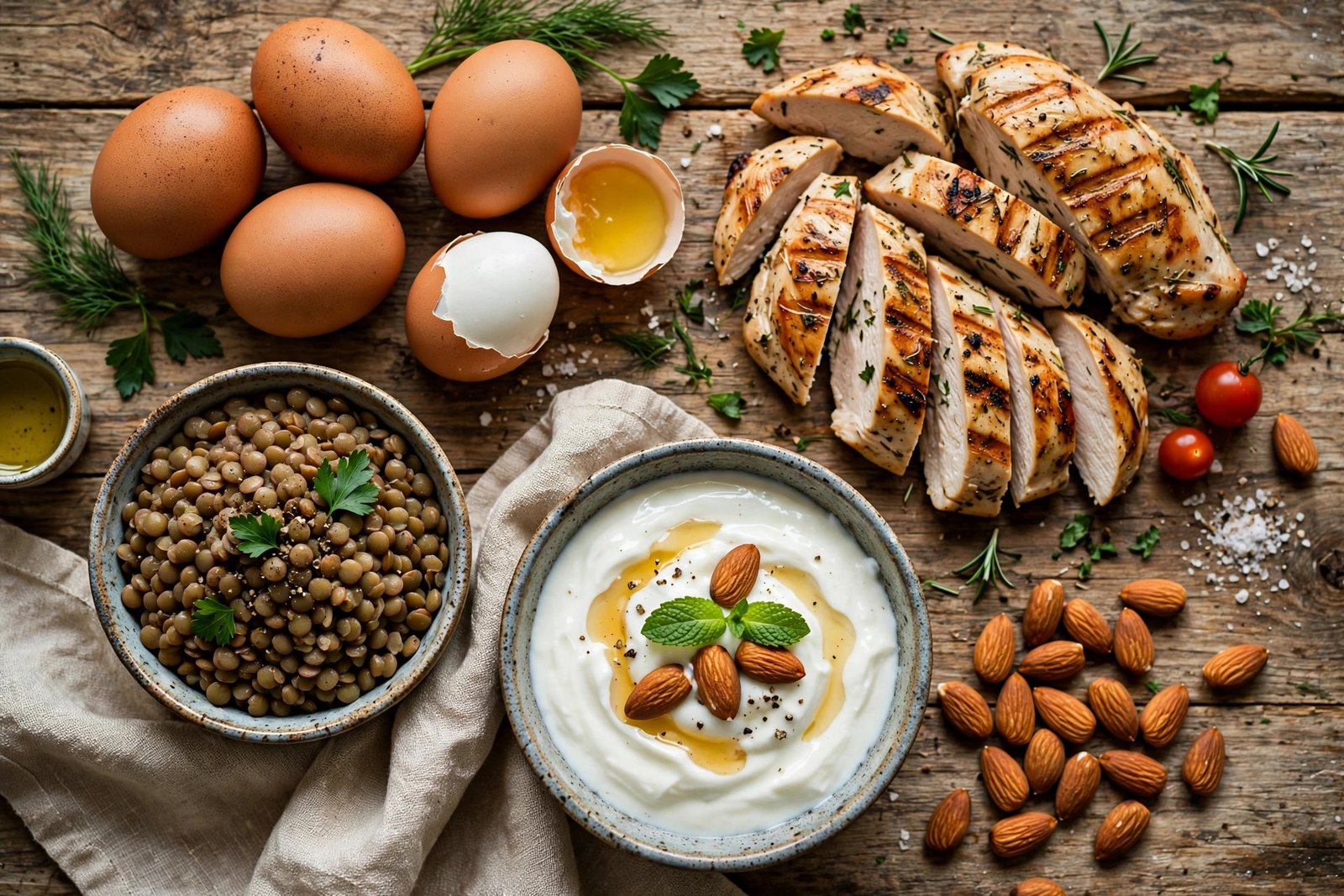
Protein-Rich Foods: What a Serving Actually Delivers
A daily target in grams is only useful if you can picture it on a plate. These are standard reference values for common protein sources — use them to build meals that add up to your calculator result instead of guessing.
| Food | Serving | Protein |
|---|---|---|
| Chicken breast (cooked, skinless) | 100 g | ~31 g |
| Whey protein powder | 1 scoop (30 g) | ~24 g |
| Canned tuna (in water) | 85 g (3 oz) | ~22 g |
| Salmon (cooked) | 85 g (3 oz) | ~22 g |
| Lentils (cooked) | 1 cup (198 g) | ~18 g |
| Greek yogurt (non-fat, plain) | 170 g | ~17 g |
| Eggs (whole) | 2 large | ~12 g |
| Firm tofu | ½ cup (126 g) | ~10 g |
Three or four servings from this list, spread across the day, cover the target for most people. Plant-based eaters can lean on lentils, edamame, tofu and Greek yogurt (if vegetarian), and pairing grains with legumes across the day covers all essential amino acids.
Frequently Asked Questions
How much protein do I need per day?
It depends on activity and goals: roughly 1.0–1.2 g/kg for sedentary adults, 1.4–1.6 for moderately active, 1.6–2.2 for athletes or muscle gain, with +0.2 g/kg when losing fat. A 70 kg moderately active person needs about 98–112 g/day.
Is 0.8g of protein per kg enough?
0.8 g/kg is the official minimum to prevent deficiency in sedentary adults — not an optimum. Active people, dieters and adults over 65 do better at 1.2 g/kg and above.
How much protein per meal?
Aim for 25–40 g of protein per meal across 3–4 meals. Muscle protein synthesis responds better to spread-out doses than to a single large serving.
Do I need more protein to lose weight?
Yes — about 0.2 g/kg more than your training baseline. Extra protein preserves muscle in a deficit and keeps you fuller, which makes the diet easier to sustain.
Can you eat too much protein?
Above roughly 2.2 g/kg there is little extra benefit for most people, and very high intakes can crowd out fiber, carbs and fats. People with kidney disease should follow medical guidance.
Does protein timing matter?
Total daily intake matters far more than timing. A post-workout meal within a few hours is sensible, but hitting your daily target beats any timing trick.
How much protein do I need per pound of body weight?
Convert the g/kg ranges by dividing by 2.2. The RDA of 0.8 g/kg is about 0.36 g/lb; active people land around 0.55–0.73 g/lb (1.2–1.6 g/kg), and building muscle takes up to roughly 1.0 g/lb (2.2 g/kg). For a 154 lb (70 kg) lifter, that is about 112–154 g of protein per day.
What foods are highest in protein?
Per typical serving, chicken breast (~31 g per 100 g cooked), whey protein (~24 g per scoop), tuna and salmon (~22 g per 85 g) lead the list. The strongest plant sources are lentils (~18 g per cooked cup), edamame and tofu. See the food table above for serving sizes.
Do I need protein powder to reach my target?
No. Powder is a convenience, not a requirement — whole foods can cover any target this calculator produces. A scoop (~24 g) is simply useful when appetite, time or a post-workout window makes a full meal impractical. Food protein and powder protein count exactly the same toward your daily total.
Final Thoughts
Protein is the one macro almost everyone under-eats relative to their goals. Calculate your range, split it across your meals, and run it for a month — better recovery, better satiety and better body-composition results usually follow.
Protein Sorted? Plan the Rest
Build full daily targets with our macro calculator and calorie calculator.