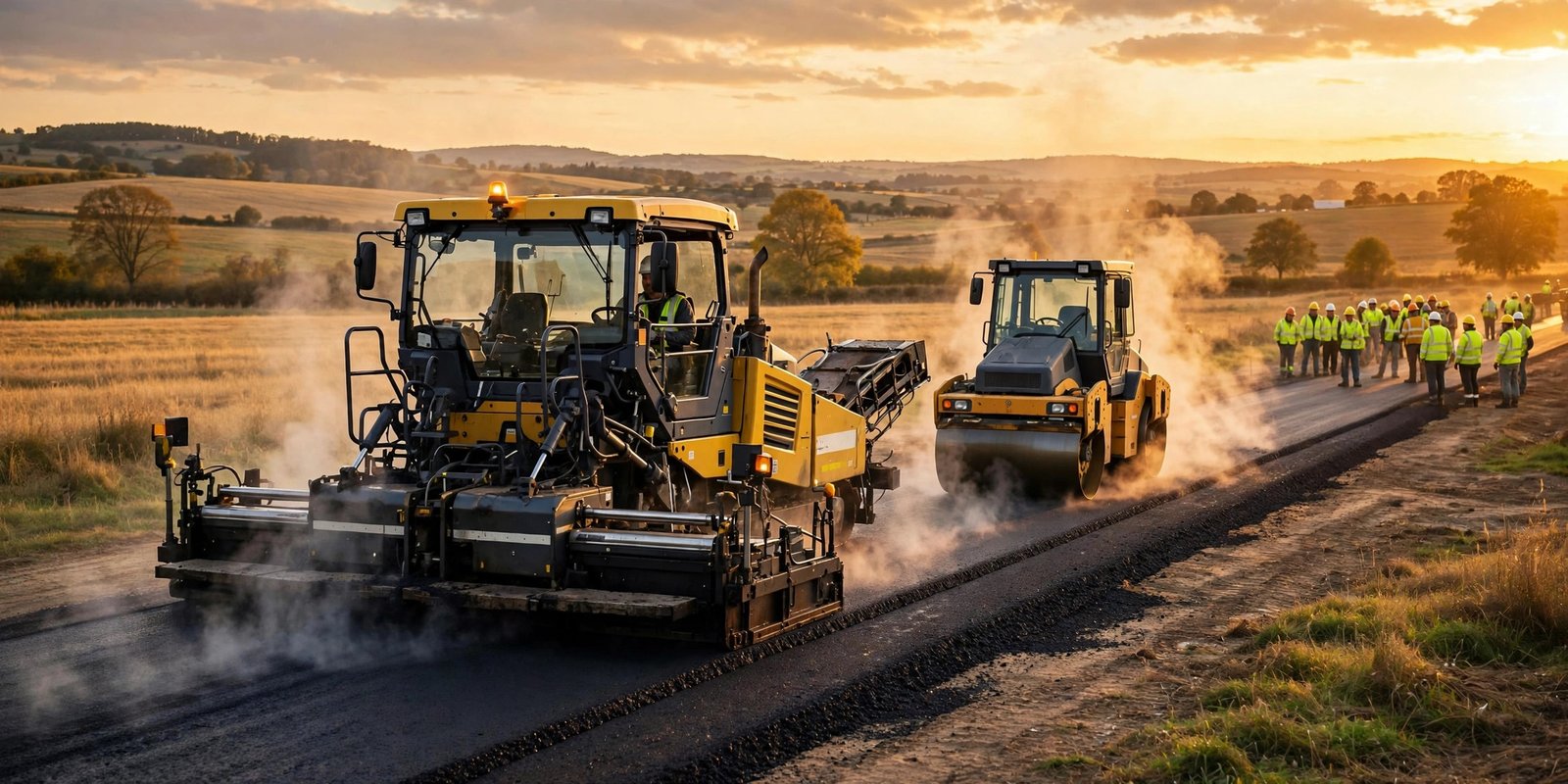
Order Too Little and the Paver Waits; Order Too Much and You Pay for It Twice
Asphalt is sold by the ton, but driveways and parking lots are measured in feet. Converting between the two takes the weight of compacted hot mix into account — and that’s where most people either overshoot their budget or stall the paving crew mid-job. Ordering short by even a couple of tons can leave a seam you’ll see forever.
This free asphalt calculator does the conversion for you: enter your length, width, and thickness, add a waste allowance, and get the tonnage to order — plus cubic yards, truckloads, and an estimated material cost.
Tonnage · cubic yards · truckloads · cost
Please enter a length, width, and thickness above 0.
Asphalt needed for your project
Hot-mix asphalt, 145 lb/ft³ density
Based on compacted hot-mix asphalt at the industry-standard 145 lb per cubic foot. A 20-ton dump truck is the standard haul size; smaller trucks need more loads. Confirm the mix density and delivered price with your local supplier before ordering. Estimates only — not a quote.
How to Use This Calculator
- Enter the length and width of the area to be paved, in feet or meters.
- Enter the compacted thickness in inches or centimeters — or tap a preset (driveway, parking, overlay).
- Set a waste factor — 10% is the default, which covers edge trimming and spillage.
- Add your price per ton (optional) to estimate the material cost.
- Click Calculate — get tons, cubic yards, metric tonnes, truckloads, and the full math behind them.
What Is Hot-Mix Asphalt?
Hot-mix asphalt (HMA) is the black paving material used for most driveways, parking lots, and roads. It’s a blend of crushed stone, sand, gravel, and asphalt cement — a sticky petroleum-based binder — mixed at very high temperatures at an asphalt plant, trucked to the site, and laid while still hot. Once it cools and is compacted by rollers, it hardens into the smooth, durable surface you drive on.
What matters for estimating is that compacted HMA is heavy: about 145 pounds per cubic foot. That density is the industry standard used for ordering, and it’s what this calculator is built on.
The Asphalt Formula
Weight (lb) = Volume × 145 lb/ft³
Tons = Weight ÷ 2,000
Worked example
A driveway that’s 100 ft long × 20 ft wide, paved 3 inches thick, with a 10% waste allowance:
- Volume: 100 × 20 × 0.25 = 500 ft³ (18.52 yd³)
- Weight: 500 × 145 = 72,500 lb
- Tons: 72,500 ÷ 2,000 = 36.25 tons
- With 10% waste: 36.25 × 1.1 = 39.88 tons to order
- Truckloads: 39.88 ÷ 20 = 1.99 → round up to 2 trucks
At $120 per ton, that job’s material would run roughly $4,786 — before delivery, grading, and the base layer.
Recommended Thickness by Project
| Project type | Compacted asphalt | Stone base |
|---|---|---|
| Residential driveway | 2–3 in (50–75 mm) | 4–6 in of compacted aggregate |
| Light commercial parking | 3–4 in (75–100 mm) | 6–8 in of compacted aggregate |
| Heavy traffic / truck lanes | 4–6 in (100–150 mm) | 8–12 in engineered base |
| Overlay on existing pavement | 1.5–2 in (40–50 mm) | None (existing surface, often milled first) |
Thicker isn’t automatically better — the stone base underneath does the structural work. A proper base with 2–3 inches of asphalt outlasts 4 inches laid over poor ground.
Quick Reference: Tons per 1,000 Square Feet
Estimating a whole driveway or lot at once? These figures use the same 145 lb/ft³ density as the calculator, before your waste allowance:
| Compacted thickness | Tons per 1,000 sq ft | Coverage per ton |
|---|---|---|
| 2 in | ≈ 12.1 tons | ≈ 83 sq ft |
| 3 in | ≈ 18.1 tons | ≈ 55 sq ft |
| 4 in | ≈ 24.2 tons | ≈ 41 sq ft |
| 6 in | ≈ 36.3 tons | ≈ 28 sq ft |
Tips for Ordering Asphalt
- Always add waste. 5–10% covers edge trimming, spillage, and thickness variation over an uneven base. Running short mid-pour leaves a visible seam.
- Measure in feet, not paces. A two-foot error on a 100-foot driveway changes the order by several tons.
- Confirm the density with your supplier. 145 lb/ft³ is the standard for dense-graded hot mix; specialty mixes differ slightly.
- Ask for the delivered price per ton. Plant price plus trucking is what you actually pay — the calculator uses whatever number you enter.
- Schedule paving on dry days. Wet or freezing ground compromises compaction, and your tonnage estimate assumes full compaction.
- Don’t forget the base. A 4–6 inch crushed-stone base is a separate material order — this calculator covers asphalt only.
Frequently Asked Questions
How do I calculate asphalt tonnage for a driveway?
Multiply length by width by thickness in feet (inches divided by 12) to get cubic feet. Multiply by 145 pounds, then divide by 2,000. A 50 ft × 20 ft driveway at 3 inches = 250 ft³ × 145 ÷ 2,000 = about 18.1 tons, plus 5–10% waste.
How much does asphalt weigh per cubic foot?
Compacted hot-mix asphalt weighs about 145 pounds per cubic foot. That makes one cubic yard — 27 cubic feet — roughly 3,915 pounds, or just under 2 tons.
How thick should a residential asphalt driveway be?
Two to three inches of compacted asphalt over 4 to 6 inches of compacted crushed-stone base handles passenger cars well. Go to 4 inches if you park heavy trucks or live in a freeze-thaw climate.
How much area does one ton of asphalt cover?
Coverage depends on thickness. At 145 lb/ft³, one ton is about 13.8 cubic feet, so it covers roughly 83 square feet at 2 inches thick, about 55 square feet at 3 inches, and about 41 square feet at 4 inches.
How many tons can an asphalt truck carry?
A standard tri-axle dump truck hauls about 20 tons of hot mix — that’s the capacity this calculator uses for its truckload estimate. Smaller tandem trucks carry around 13–15 tons.
Should I add a waste factor when ordering?
Yes. Five to ten percent is the industry norm, covering edge trimming, spillage, and a base that isn’t perfectly level. It’s far cheaper than ordering a second small load — plants charge minimum fees for tiny top-ups.
Can I convert square yards to tons of asphalt?
Yes: square yards × 9 = square feet, then follow the standard formula. A handy shortcut is that one square yard of compacted asphalt weighs about 110 pounds per inch of thickness — so 3 inches on one square yard is 330 pounds, or 0.165 tons.
How many tons of asphalt do I need for 1,000 square feet?
At 145 lb/ft³: about 12.1 tons at 2 inches thick, 18.1 tons at 3 inches, 24.2 tons at 4 inches, and 36.3 tons at 6 inches — then add your 5–10% waste allowance.
Final Thoughts
The math behind an asphalt order is simple — it’s the forgetting that’s expensive. Measure carefully, add your waste allowance, and confirm the delivered price per ton with two or three local suppliers before you book the paver. A tonnage estimate you can show the contractor is also your best defense against over-ordering.
Paving the Whole Project?
Estimate your base material with our pea gravel calculator and plan volumes with our cubic yard calculator.